
About the Artist
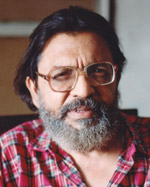 Suraj Ghai’s work stands out from mainstream contemporary art on several counts. Firstly, he is an artist for whom feeling is paramount. Whether in his figurative or abstract compositions, in his landscapes or portraits, his point of departure has always been a feeling or a complex of feelings. This brings him close to the ancient Indian masters who, regardless of the theme or motif in hand, aimed to express an abstract emotion or ideal in concrete, visual form. It is not that he consciously creates according to the theory of ‘Rasa’, yet his work underlines the timeless and universal applicability of this theory.
Although the present exhibition is predominated by melancholy, Ghai’s vision is far from pessimistic. An artist who clearly delights in the sensuousness of the oil medium and the limitless potential of his palette, he builds up images that defy negativity. These are sometimes detached and silent like the Sarnath Buddha and sometimes thrown on to the eye through their linear energy or daring oppositions of colour. But they are never the self- indulgent outpourings of existentialist angst. Like a sad song or symphonic movement, they seek to give form to, and heighten, a universal feeling.
Ghai’s imagery is also marked by a rare poetic quality, best exemplified by his variation on theme of ‘Lovers’, Black Flowers: Ravages of War, Naked Prince and the Birds and Nude in the Stream. Like all his works, these are articulated in a modern idiom that owes much to Matisse; yet in common with the Bodhisattva Padmapani and The Dying Princess at Ajanta, they invite the Rasika to taste compassion. There is also great lyricism in Little Girls Frolic in the Twilight in the Garden; but here the mood changes to wonder and buoyancy; the blue version in particular chases away the sadness so often experienced at this hour.
A further rare quality in Ghai’s works is humour. Earlier we saw it in his satirical drawings. Here it bites subtly in paintings such as Swan – Snake. And in the burlesque – like Orgy at His Recurring Crucification it is gleefully trenchant; the artist has revelled in mocking evil.
The glint is seldom absent in Ghai’s eye. This is why his songs of melancholy light up our path.
— Juliet Reynolds
 Suraj Ghai